
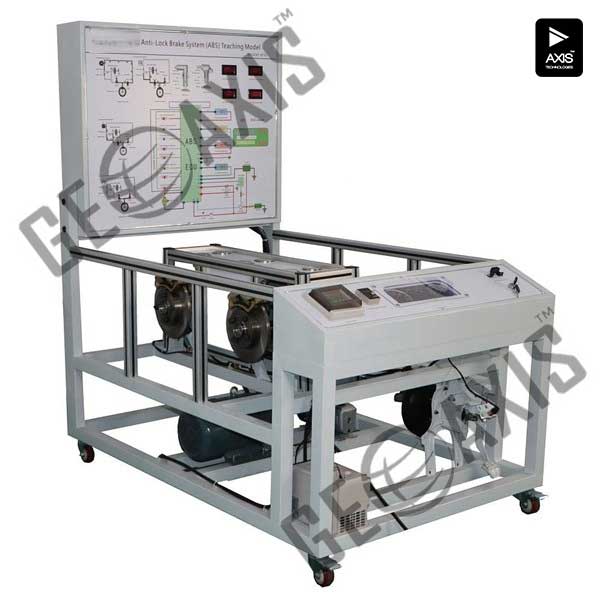
Technical parameter
1. Dimensions: 1000x1600x1800mm(L x W x H)
2. Power supply: AC 220V/ 50Hz
3. Brake fluid: DOT3
4. Frequency converter: 5.5KW, Input: AC380V/50/Hz, Output: Three phase, AV380V/0-400Hz
5. Drive motor: AC380V/50Hz, 4KW, Speed: 1440 r/min;
6. Vacuum pump: AC220V/50Hz, 0.37kw, speed: 1400 r/min.
Product description
The trainer demonstrates structure and working principle of the auto ABS braking system.
| Inverter | 1PCS |
| ABS controller | 1PCS |
| Speed sensors | 1PCS |
| Disc brake | 1SET |
| Drive motor | 1PCS |
| ABS ECU | 1PCS |
| Pressure gauges | 1SET |
| Fault set module(Manual switch type) | 1PCS |
| Mobile stand with test panel | 1SET |
Main features
1. Adopting a real car ABS braking system, fully demonstrating the composition and structure of the ABS braking system.
2. Use a driving motor to drive the transmission shaft to rotate to simulate car driving. Can demonstrate the working process of the automotive ABS system.
3. The test panel is equipped with ABS system circuit diagrams and hydraulic pipeline diagrams, allowing students to intuitively understand and analyze the working principle of the control system.
4. There are detection terminals installed on the test panel, which can directly detect the electrical signals of various
sensors and control unit pins on the panel, such as resistance, voltage, current, frequency signals, etc.
5. The training platform is equipped with a pressure gauge that can display the hydraulic changes of the brake master cylinder and four brake wheel cylinders in real-time.
6. The training platform is equipped with a fault indicator light and diagnostic base, which can be connected to a scanner to read fault codes, clear fault codes, read data streams, perform component testing, parameter setting, waveform analysis, and other self diagnostic functions.
7. Equipped with fault setting module: manual switch type (optional intelligent type)
Training courses
1. Function introduction of main components of the ABS brake system;
2. Work principle introduction of the ABS brake system;
3. Demonstration of how the ABS brake system works when braking;
4. Measurement of the signals of the sensors and actuators of the ABS brake system;
5. Fault setting and troubleshooting.
6. Use of the scanner
Suitable car models listed below:
| P.N. | Car model | P.N. | Car model |
| MATL-2011-001 | Volkswagen Jetta ABS | MATL-2011-003 | Volkswagen Passat ABS/EBD/ASR |
| MATL-2011-002 | Volkswagen Passat ABS/EBD | MATL-2011-004 | Toyota Lexus ABS/EBD |
| MATL-2011-005 | Toyota Corolla ABS/EBD |